
What’s in a Glaze? (And Why Yours Has Character)
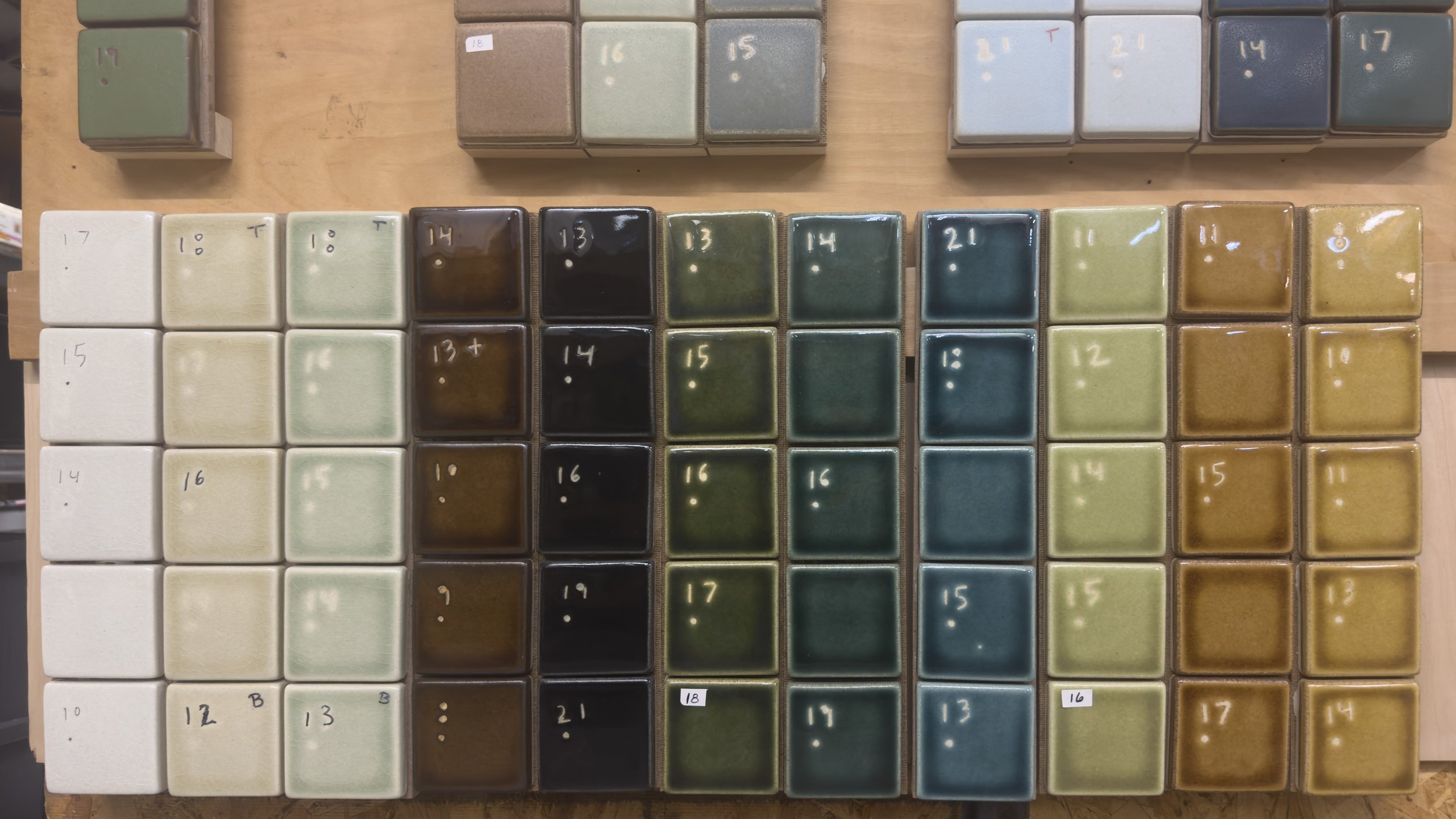
Glaze range samples show the variety of shades in each color that give Motawi tiles their distinctive handmade appearance
“Ceramics is a moment in time.” –Sarah Fuller, Retail Manager
“It’s still a recipe from the earth.” –Brent Westrick, Kiln Room Lead
If you’ve ever held two Motawi field tiles of the same color and thought, “Hmm, these aren’t exactly identical,” you’ve spotted the magic. This post is our friendly guide to that magic—why glazes vary a little in color, thickness and surface, and why we embrace that variation.
A bit of history
“A lot of the first glazes were probably just accidents,” Brent explains. “Someone made a clay pot, put it in a fire, and ash from the wood melted onto it. That was the first glaze. And honestly, it’s still kind of like that—just more controlled now.”
Fast‑forward a few thousand years and we’ve traded campfire ash for carefully measured ingredients, but the heart of the process hasn’t changed: glaze is a recipe. And because many of the ingredients still come from the earth, nature has a hand in the outcome.
Handmade on purpose
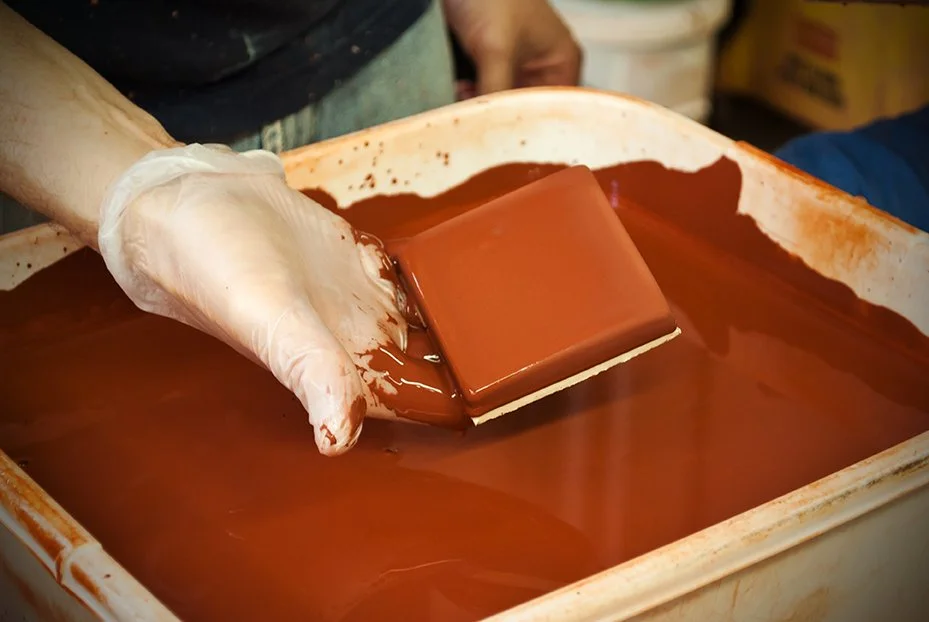
Hand-Dipping a Field Tile in Glaze
As the tile is lifted from the glaze, gravity takes over—leaving a slightly thicker, deeper tone where the glaze flows away. It’s part of Motawi’s handmade signature.
At Motawi Tileworks, we dip‑glaze our field tiles by hand. A human (often the same few humans) picks up each tile, immerses it in glaze, and lifts it out at an angle, to let the excess glaze drip off. That human motion is part of the look: you might notice a difference from one edge to the other—a soft highlight on the tilted-up edge, and a darker shade where the glaze ran off and became slightly thicker. It’s a subtle signature that sprayed or machine‑applied glazes don’t leave behind—and we like it that way.
Brent puts it this way: “That little difference from the top to the bottom of a tile—that’s Margaret’s hand coming out of the glaze. It’s the reminder that every piece was touched by a person, not a robot.”
We also set a “range” for every color—our acceptable window for thickness and tone—because a little variation brings life. Your sample chip shows the mood; the range shows the personality.
What makes glazes vary?
Let’s pull back the kiln door:
1) Application (aka, thickness).
Even with well‑trained hands and tight standards, hand‑dipping introduces minute differences. A hair thicker = deeper tone; a hair thinner = lighter tone. We design each glaze so it looks great across that planned range.
2) Ingredients from the earth.
“Some of our materials just come from dirt,” Brent says with a grin. “Iron oxide, feldspar, copper—they’re mined. One batch might have a little more iron, another a little less. That’s part of what keeps glazes alive.”
A real‑world example: when a widely used feldspar went out of production, the ceramics world (us included) had to audition substitutes. “It was like someone told every baker in the world, ‘Sorry, you can’t use flour anymore.’ We all scrambled to find something that behaved close enough,” Brent recalls.
3) Firing environment.
Tiles are fired in computer-controlled gas kilns at Motawi. Gas kilns give us outstanding consistency and throughput, but the way flame and oxygen move through the kiln can still subtly influence certain colors. Even a change of about a hundred degrees, or a small shift in oxygen, can change how a glaze melts and matures.
4) Neighbor effects (aka, kiln vibes).
Glazes can release faint “fumes” during firing. Put the wrong neighbors too close together and you might wake up to a surprising tint. “Once,” Brent laughs, “I put white tiles next to a chrome‑heavy black glaze and ended up with mint‑chocolate‑chip green. Lesson learned.”
Why we choose character over clones
We could chase perfect uniformity with heavy automation and spray booths. We tried a super‑uniform method once; the results were tidy…and a little lifeless. “We even had a machine that drizzled glaze like chocolate syrup on a conveyor belt,” Brent remembers. “It was too perfect. Everything looked flat.”
Our practice is rooted in the handcrafted traditions we love, so we choose the approach that gives tiles soul: human touch, graceful ranges, historical depth.
Setting expectations (the friendly fine print)
Samples are a guide, not a paint chip. Each color has an intentional range. Expect siblings, not clones.
Order for your whole project at once when color continuity is critical (kitchens, baths, fireplace surrounds). Materials can shift over years or even months industry‑wide.
Keep a few extras from your batch for future tweaks or repairs.
Re‑orders years later may not be an exact match. We’ll get as close as possible within today’s materials and ranges. If you’re adding on, consider a design move (a border, frame, or planned contrast) that celebrates the difference.
Field vs. art tile: Single‑color field tile is tuned for harmonious consistency within its range; multicolor art tile leans into painterly variation by design.
Temperamental beauties (and tough calls)
Some glazes are divas (we say it lovingly). “Granite was one,” Brent notes. “When one of its ingredients went out of production, I tried every substitute I could find, but it just wasn’t the same. We finally retired it rather than send out something that didn’t have that spark.”
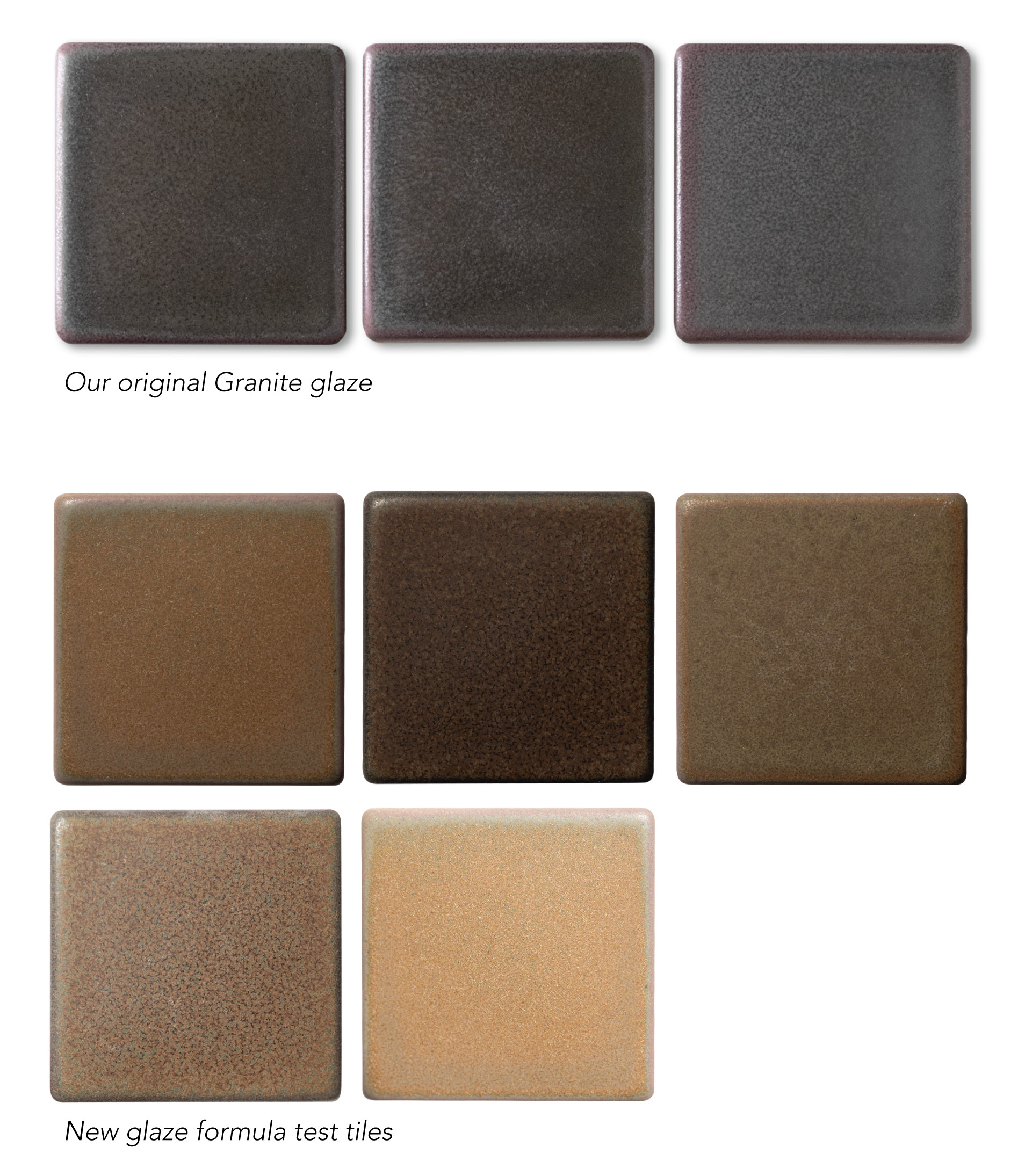
When a key ingredient changed, we tested extensively to reformulate our Granite glaze (shown above). Despite many trials, none captured the depth and character of the original. Granite has since been retired.
The kiln choreography
Firing isn’t just “turn it on and wait.” We program ramps—periods of steady temperature climb and gentle holds—so gasses burn out, bubbles smooth, and the glossy melt settles into a strong surface. Brent describes it like cooking down caramel: “You bring it up, let it work, and give it time to clear so the finish is luscious, not fizzy.”
Why your tile is uniquely yours
Every Motawi piece records a small stack of moments: the miner’s vein, the batch we mixed, the glazer’s lift, the tiles that sat nearby, the kiln’s breath that day. “That’s what I love,” Brent says. “Each firing tells its own story.”
Those moments add up to what you see on your wall. It’s bespoke by nature—and we think that’s worth celebrating.
Quick FAQ
Can you match my five‑year‑old installation?
We’ll try—send photos and dimensions—but you should expect slight differences to glaze colors on tiles that are ordered at different times. A design tweak (a frame or accent color), on the other hand, can make old and new play beautifully together.
My sample chip looks a shade deeper than my finished tile. Why?
Thickness, firing and batch chemistry all nudge tone. Your installation is still within the planned range.
Can you make my tiles more/less varied?
No. That’s why we offer range samples, so you know to what degree the color or colors you’ve selected may vary. But there’s no guaranteed amount of lighter or darker tiles in a given order. What we can guarantee is that your tiles will fall within what we consider the acceptable range.
Where can I see this in person?
Visit our Ann Arbor gallery or hop on a Friday factory tour to peek into the kiln room and see the process up close. You may also order samples online.
If you’re drawn to the warmth and honesty of craft, glaze variation isn’t a flaw—it’s what makes a Motawi tile distinctive.
Take a closer look in the Design Studio, or reach out and we’ll help you plan a stunning glaze range for your project.